
Article: Best Fabric for Leggings: What Your Label Won't Tell You About Cotton, TENCEL™ and Polyester
Table of Contents
Best Fabric for Leggings: What Your Label Won't Tell You About Cotton, TENCEL™ and Polyester
This page may contain affiliate links. We may earn a commission on purchases, at no additional cost to you. Learn more →
Method: claims are checked against peer-reviewed research, agencies, certification bodies and fiber makers' documents. Orbasics' own wear tests and my opinions are labeled as such, not lab results.
Have you ever done everything right and still ended up with the wrong workout leggings? You read the reviews. You paid good money. Three weeks later they sag at the knees, pill between the thighs and turn see-through in a squat. Or they keep their shape, and you peel off a clammy layer of plastic after every workout.
Leggings sit closer to your skin than almost anything you own, often for hours, through sweat and heat. When I read how many chemicals end up in conventional activewear fabrics, I couldn't look at a leggings label the same way again.
Most guides still say: buy a polyester spandex blend or a nylon spandex blend. I see it differently. The best fabric for leggings isn't one fiber. It's fiber, knit, weight, stretch and finish working together. Here's what I've learned building low tox clothing at Orbasics, including where our own fabrics fall short.
Key Takeaways
No fiber wins alone. A review of 32 sports-clothing studies found few consistent natural-vs-synthetic differences.
Cotton is soft and comfortable but holds sweat in intense workouts.
TENCEL™ Lyocell handles moisture and feels cool and soft, but can pill.
Polyester dries fast but is plastic. Nylon differs from polyester.
Spandex percentage is a clue, not a compression rating. No GSM number guarantees squat proof leggings.
PFAS is a finish problem, not a fiber problem.
What Actually Makes the Best Fabric for Leggings?
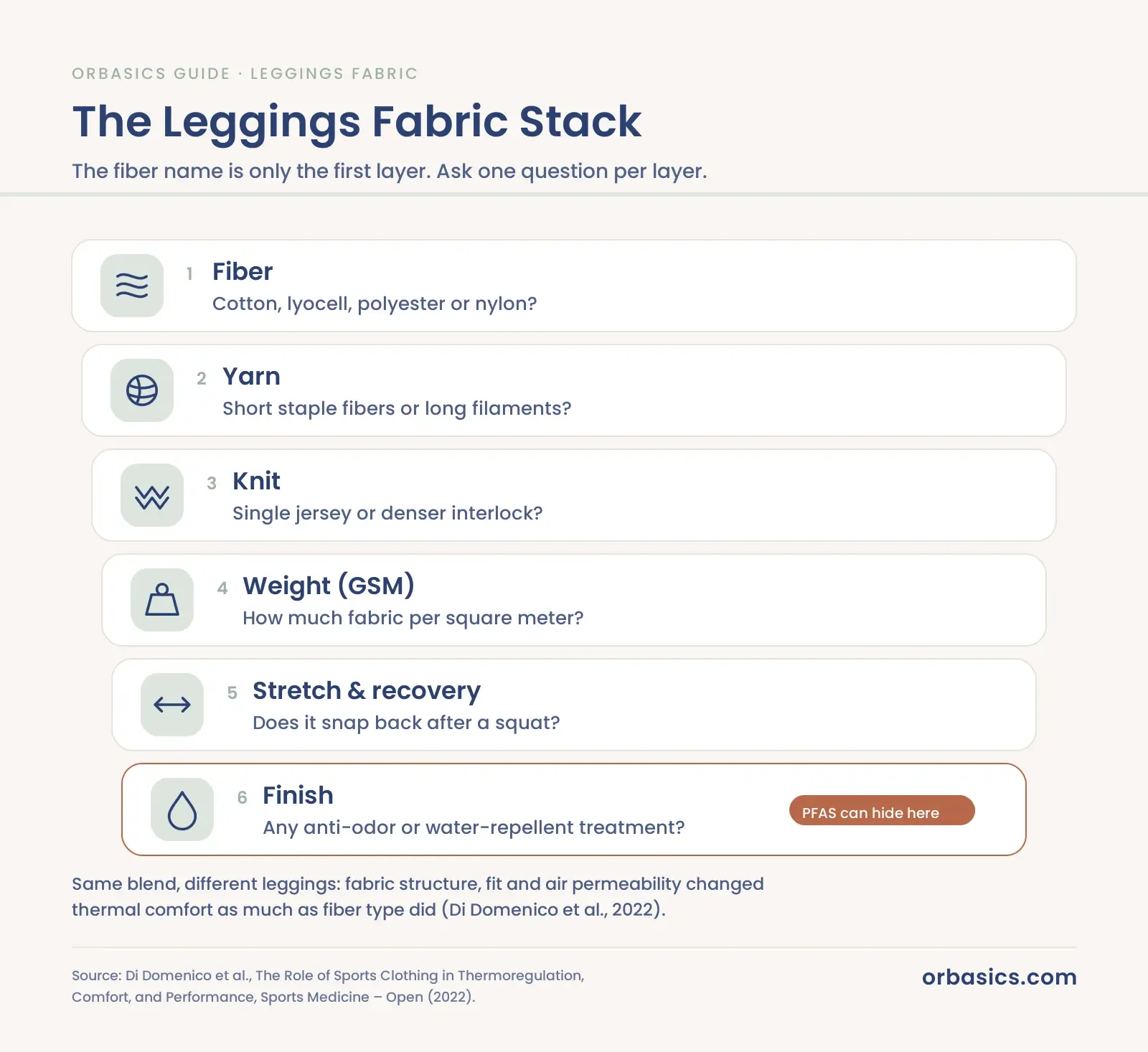
"92% polyester, 8% spandex" is only the first layer. Two pairs with the same blend can feel completely different, because the finished garment depends on:
-
Fiber: cotton, lyocell, polyester, nylon
-
Yarn: short staple fibers or long filaments
-
Knit: single jersey or denser interlock
-
Weight (GSM): grams per square meter
-
Stretch and recovery: how well it snaps back
-
Finish: dyes, anti-odor or water-repellent treatments
In the 2022 Sports Medicine – Open review, fabric structure, fit and air permeability changed thermal comfort as much as fiber type did. So choosing the right fabric means reading past the fiber name.
We cover other materials and athletic wear in our full workout fabric comparison.
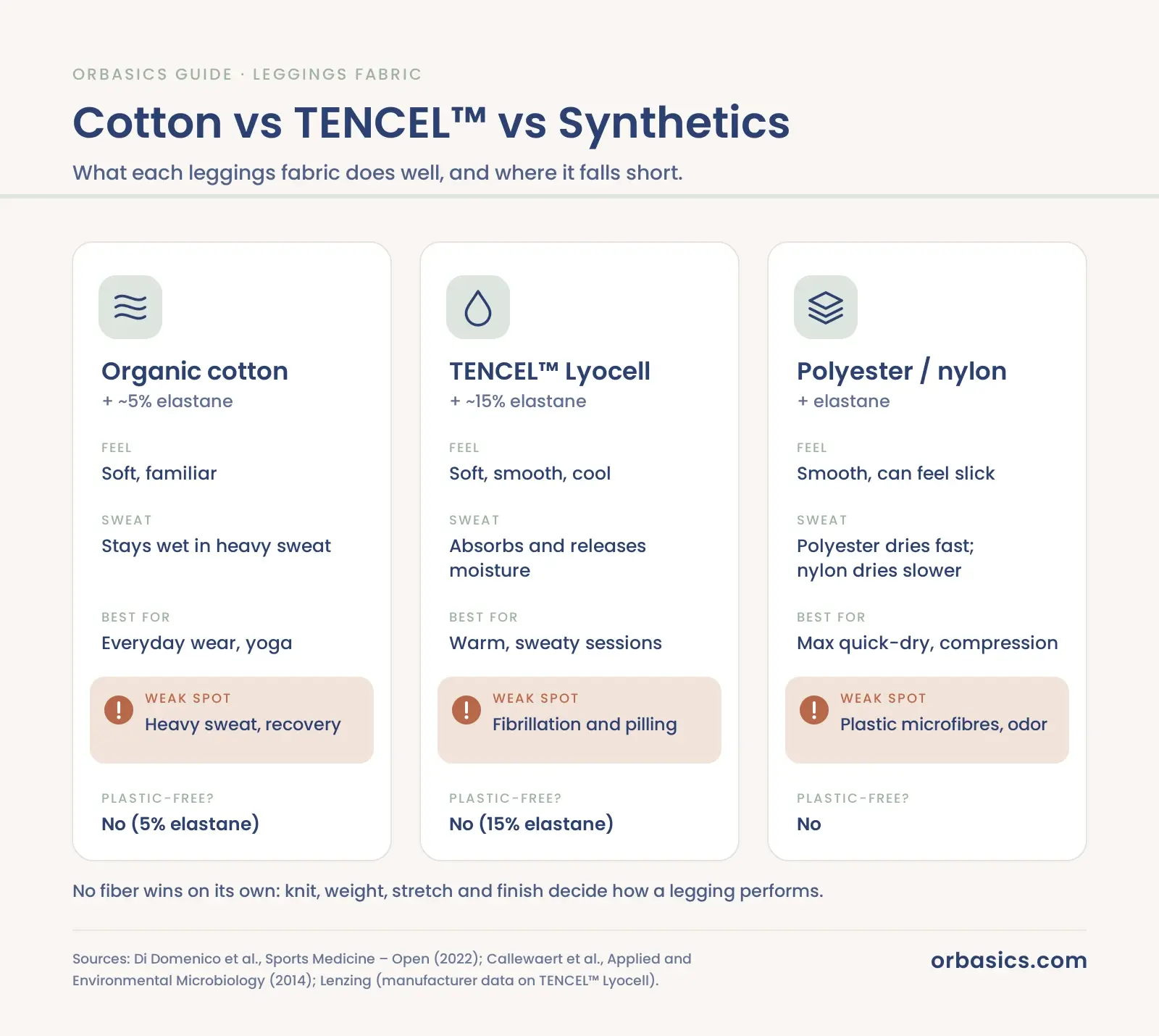
Cotton vs TENCEL™ Lyocell vs Polyester vs Nylon: The Comparison
Organic Cotton + Elastane
Organic cotton fabric is where Orbasics began. It's soft and breathable, with a softness that feels like home.
But cotton absorbs sweat and doesn't wick moisture away. In intense workouts, it turns wet and clingy. It does win one round: in a controlled fitness-class study, worn polyester shirts smelled stronger and less pleasant than cotton.
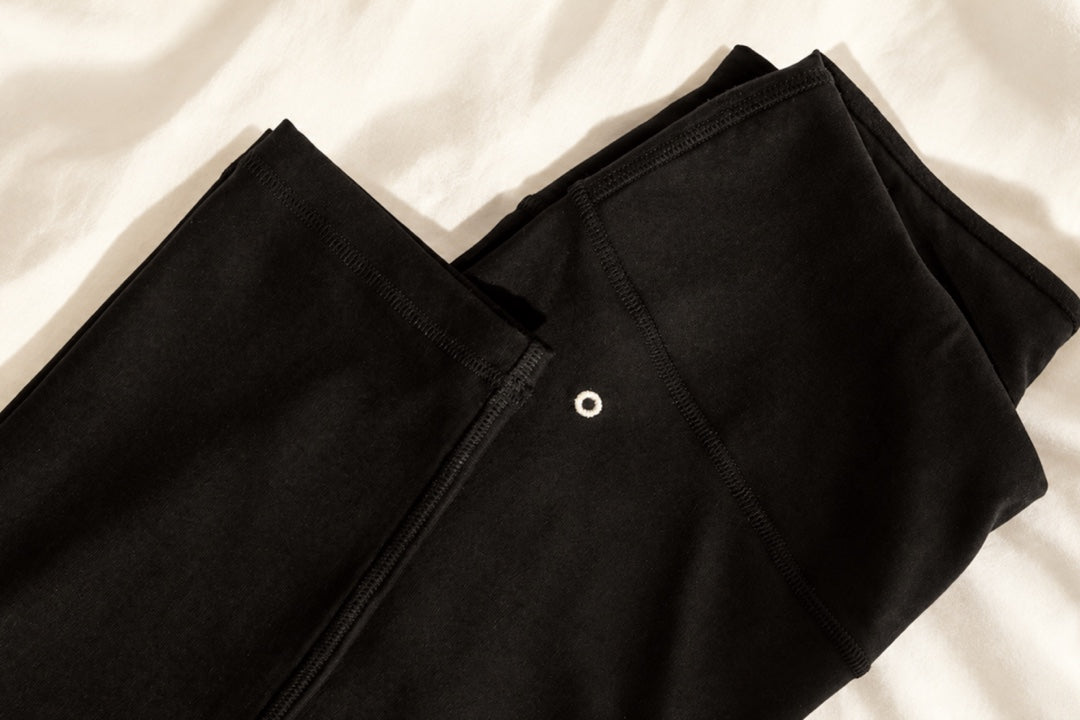
Our organic cotton high-waist leggings are 95% GOTS-certified organic cotton and 5% elastane at 200 g/m². Customer feedback on them has been excellent. Still, I wouldn't send you to a marathon or a hot yoga class in them.
TENCEL™ Lyocell + Elastane
As we explained in our guide to TENCEL™ Lyocell, it's regenerated cellulose from wood pulp, not a classic natural fiber like cotton. Okubayashi, Griesser and Bechtold documented strong moisture sorption in lyocell. Lenzing, its manufacturer, says the fiber absorbs and releases moisture for a drier microclimate. That's their claim. The downside I won't hide: lyocell can fibrillate and pill.
Polyester Spandex Blend
This is the default for athletic leggings: lightweight, quick drying and durable. But sweat can sit on your skin, and the review found no consistent comfort advantage over natural fibers. And as we've shown before, polyester is plastic, recycled or not. Recycled polyester leggings shed microfibres just the same or worse.
Nylon Spandex Blend
Nylon isn't polyester under another name. According to the 2022 review, it absorbs more moisture and generally dries more slowly. It's soft, known for durability, and often sold as "Lycra fabric" (LYCRA® is actually a spandex brand). It's still a synthetic polymer.
|
|
Organic cotton + ~5% elastane |
TENCEL™ Lyocell + ~15% elastane |
Polyester / nylon + elastane |
|---|---|---|---|
|
Feel |
Soft, familiar |
Soft, smooth, cool |
Smooth, can feel slick |
|
Sweat |
Stays wet in heavy sweat |
Absorbs and releases moisture |
Polyester dries fast; nylon slower |
|
Weak spot |
Heavy sweat, recovery |
Fibrillation and pilling |
Plastic microfibres, odor |
|
Plastic-free? |
No (5% elastane) |
No (15% elastane) |
No |
Based on Di Domenico et al. 2022, Callewaert et al. 2014 and Lenzing manufacturer data.
Infobox: What about bamboo and viscose? Most "bamboo" fabric is viscose, and the FTC requires it to be labeled rayon. Fact is, toxic chemicals are used in the process of yarn production. Bu, it's soft and breathable, but it absorbs a lot of moisture. Here's how lyocell differs from viscose.
Which Leggings Fabric Handles Sweat Best?
Absorbing, wicking and drying are three different things. A fiber can absorb well and dry slowly. A water-repelling fiber can absorb almost nothing while the knit moves sweat along.
So is polyester better for sweat?
Half true. It often dries faster. But its moisture wicking properties don't make it breathable. That depends on how open the knit is.
Does TENCEL™ keep you cool?
In a 2023 wear trial with athletes, a TENCEL™ single-jersey T-shirt kept the skin microclimate cooler and less humid than the other shirts tested. Those were T-shirts, not TENCEL™ leggings. But it matches what I noticed in our testing: lyocell handles moisture clearly better than cotton. (For cold weather, a fleece-back knit is a different job.)
We go deeper in our guides to fabrics for heavy sweat and washing leggings so they stop smelling.
How Much Spandex Should Leggings Have?
Why Cotton Leggings Bag at the Knees
Cotton is stretchy, but it doesn't spring fully back. That's why 100% cotton leggings and tights bag at the knees and seat. It's also why leggings still need stretch, as we showed in our natural-fiber guide.
What 5%, 15% and 25% Actually Tell You
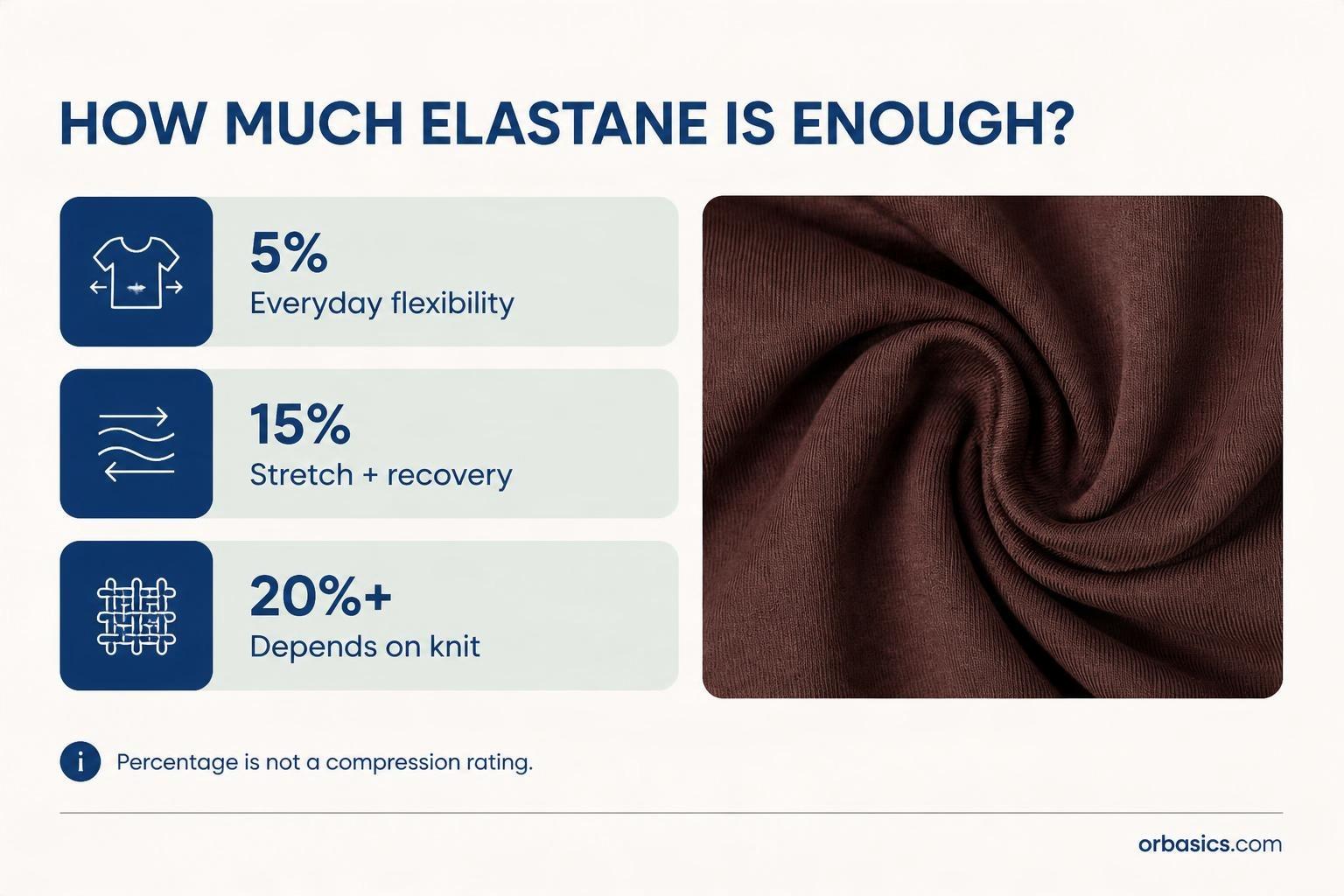
You'll often read that compression leggings need 15–25% spandex, or 80–92% nylon or polyester with 8–20% spandex. That's industry guidance, not science. Research on knitted fabrics shows elastane works together with loop length and knit structure. So what do the numbers tell you? 5% gives cotton enough recovery for everyday wear. 15% leaves room for a perfect fit that hugs. Neither is a compression class.
What Is ROICA™ V550?
ROICA™ is a family of elastane (spandex) yarns from Asahi Kasei. V550 is designed to degrade under specific conditions. In the V550 data sheet, it reached about 50% degradation after 24 months in a controlled compost test, while conventional spandex showed none. Asahi Kasei itself says 100% degradation has not been verified. We compare the grades in elastane vs ROICA™ stretch.
Squat Proof Leggings: GSM, Knit and 4-Way Stretch
Fabric suppliers often recommend 200 to 280 GSM, and lightweight fabrics below that are riskier. But I found no authoritative squat-proof standard. GSM is measured at rest. Your leggings get judged in a deep squat.
What actually decides opacity:
-
Knit density: interlock covers better than thin jersey.
-
Stretch on your body: sizing down thins every fabric.
-
Four-way stretch: freedom to move, not a quality grade.
For our new TENCEL™ line, we chose to go denser than that range: 300 GSM, for opacity and soft compression. In our testing, the samples didn't show through in squats. Our 200 g/m² cotton leggings stay opaque because of the knit, not the number. Want to check your own pair? Squat in front of a mirror in daylight.
Sewing or making leggings yourself? A fabric shop will quote weight and minimum order quantity. Ask for recovery data too. That's the fabric recommendation that matters.
Why Leggings Can Pill Between the Thighs
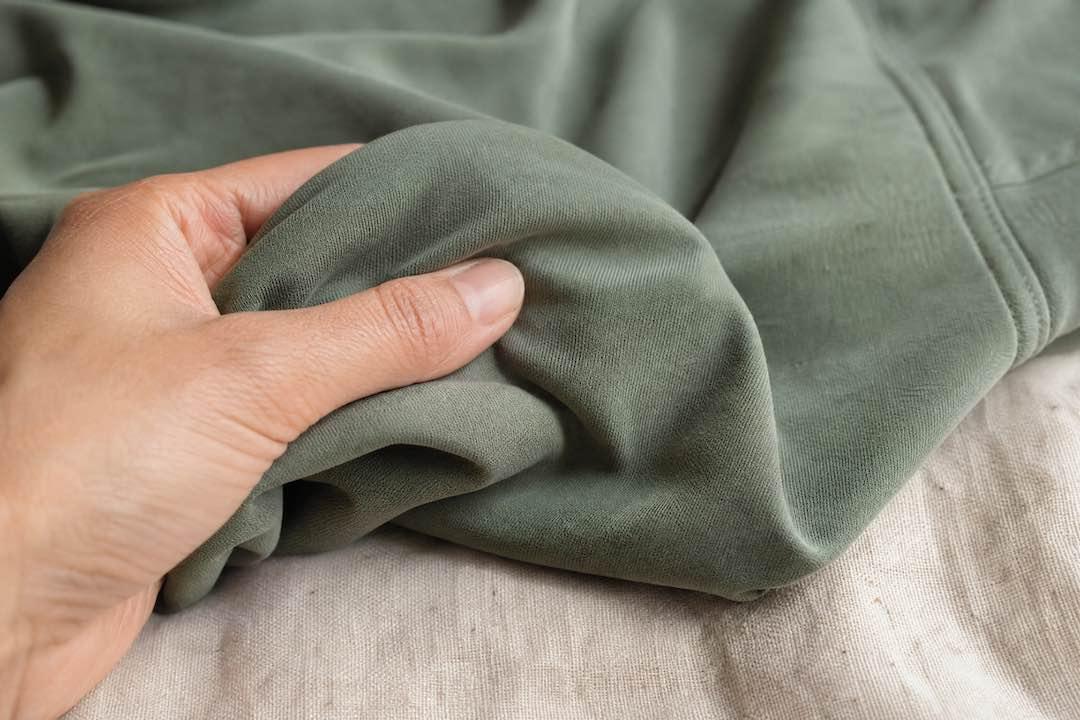
Friction pulls short fibers out of the yarn and tangles them into tiny balls. Your inner thighs rub with every step, so pills show there first. Tight knits with long filaments pill less, and strong synthetic fibers hold on to their pills.
Does TENCEL™ pill?
It can. Okubayashi and Bechtold showed that lyocell fibrillates when wet and rubbed: tiny fibrils split off and help form pills. Crosslinking and enzyme finishes reduce this, so pilling belongs to the finished fabric, not the fiber name. In our lab testing, our TENCEL™ samples haven't pilled so far.
PFAS, Finishes and Microfibres: What the Label Won't Tell You
This is the part I care about most, because you can't see it on a label.
PFAS "forever chemicals" have been used to make clothing stain- and water-resistant (NIEHS), and the EPA links some PFAS with adverse health effects.
In Mamavation's testing of 32 leggings and yoga pants, about a quarter showed a PFAS marker. We follow this closely in our guide to PFAS in workout clothes.
PFAS comes from finishes. So whether polyester contains PFAS depends on treatment, and cotton isn't automatically PFAS-free either.
Textile dermatitis research by Lisi and colleagues points mainly to dyes and finishing resins, not spandex itself. If your skin reacts easily, start with our guides to fabrics for sensitive skin and synthetic fabrics and your skin.
And microfibres? The European Environment Agency confirms synthetic textiles release microplastics through wearing and washing. It also warns that natural textiles shed fibers. The difference: cotton and lyocell fragments are cellulose, not plastic. Here's how we approach avoiding microplastics.
Why I'm Launching TENCEL™ + ROICA™ Leggings
This part is my opinion and our own wear testing.
I started looking for alternatives when I read how many chemicals end up in conventional activewear fabrics. Researchers link some plastic additives, such as BPA and phthalates, to endocrine disruption, including possible effects on hormones and fertility.
That doesn't mean wearing polyester causes infertility. But it made me look much closer, as we did in our guides to BPA in activewear and whether polyester is an endocrine disruptor. Polyester also just doesn't feel nice on my skin. But health and environmental impact were my main reasons.
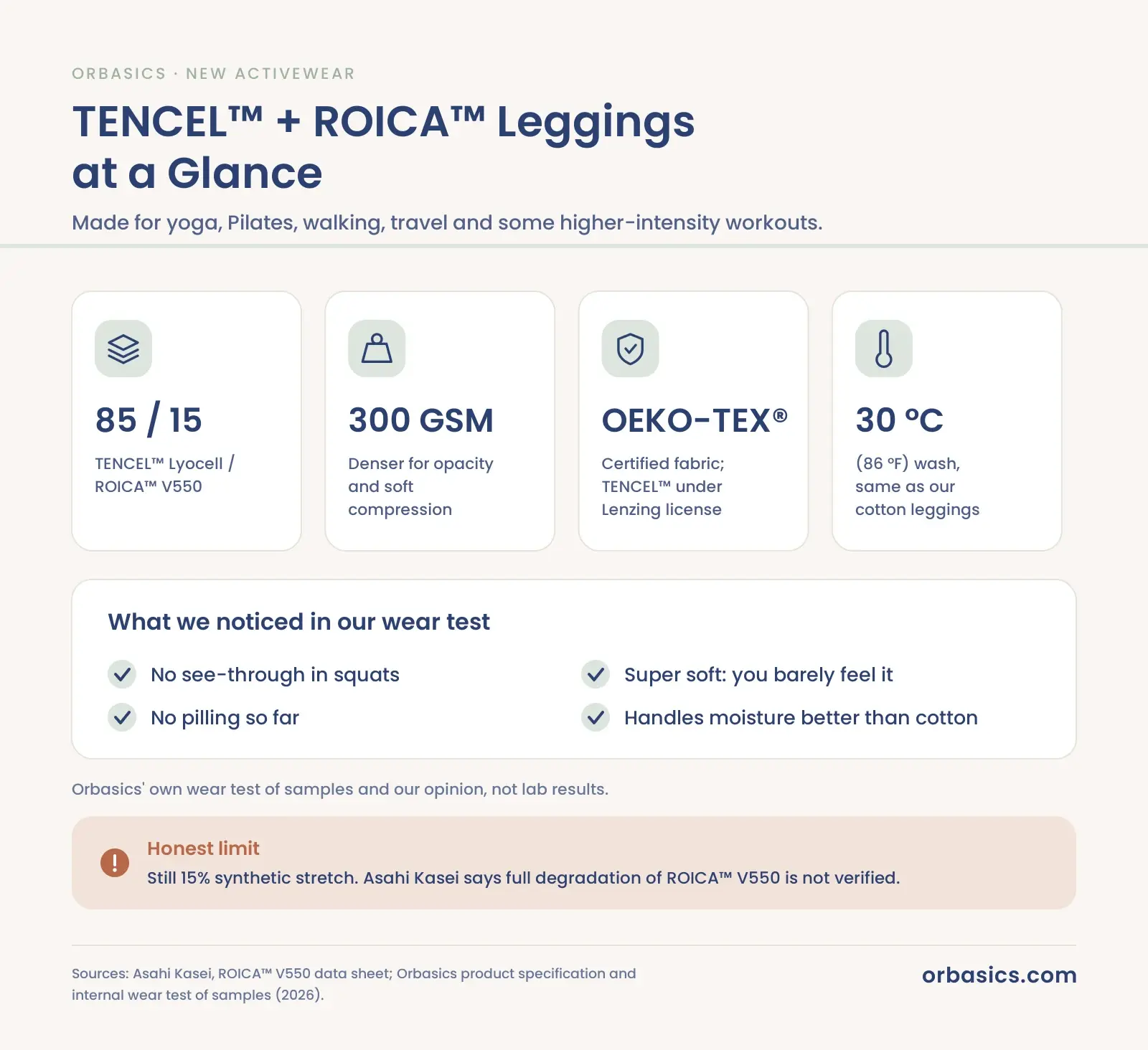
So we at Orbasics are launching leggings in 85% TENCEL™ Lyocell and 15% ROICA™ V550. They're versatile: yoga, Pilates, walking, travel, everyday movement and some higher-intensity workouts. For a marathon or hot yoga, this is the pair I'd choose over our cotton ones, because lyocell handles moisture better.
In my opinion, TENCEL™ is the best fabric for workout clothing right now. Here's why:
-
What I noticed first: you barely feel it. Our samples are super soft, with a gentle, smooth touch and an almost luxurious feel in summer.
-
Less plastic on your skin. 85% is cellulose, unlike polyester or nylon leggings.
-
You can check it. The fabric is OEKO-TEX® certified, and we use TENCEL™ under Lenzing license.
-
The most honest stretch I've found. ROICA™ V550 has the best-documented degradation data I know. It's still 15% synthetic, and full degradation isn't verified.
At 300 GSM, the 15% gives soft compression: a firm hug, not hard gymwear. Care stays simple: we wash ours at 30 °C (86 °F), like our cotton leggings. For the full comparison, see TENCEL™ vs polyester in detail and TENCEL™ or cotton on sensitive skin.
Our organic cotton leggings stay. They're still my choice for comfortable everyday wear and lighter physical activities.
How to Read a Leggings Label Before You Buy
-
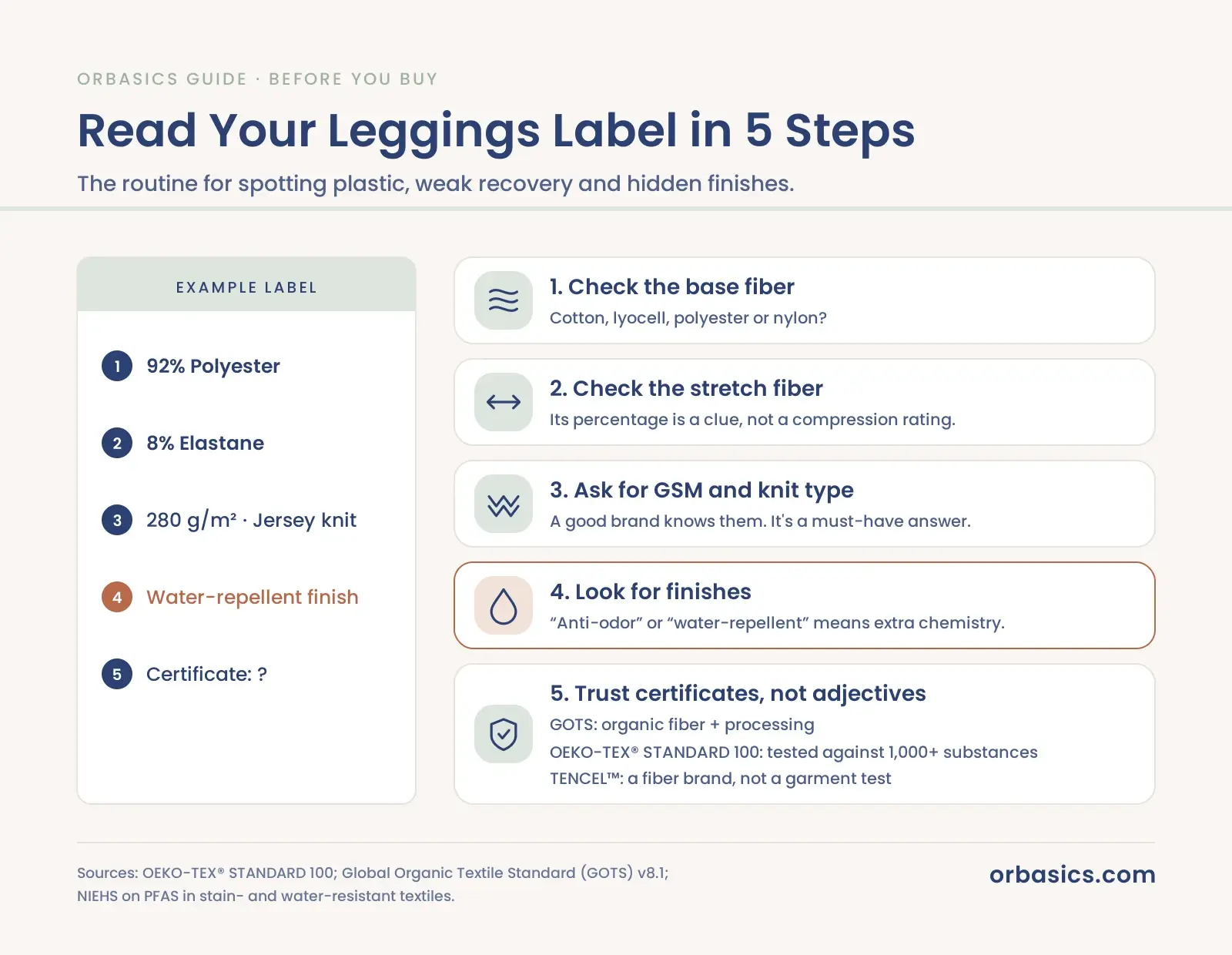
Check the base fiber. The materials list shows cotton, lyocell, polyester or nylon.
-
Check the stretch fiber. Its percentage is a clue, not a rating.
-
Ask for GSM and knit type. A good brand knows them. It's a must-have answer.
-
Look for finishes like "anti-odor" or "water-repellent."
-
Trust certificates, not adjectives. GOTS covers organic fiber and processing. OEKO-TEX® STANDARD 100 tests the finished article against more than 1,000 substances. TENCEL™ is a fiber brand, not a garment test. We compare OEKO-TEX® vs GOTS labels in detail.
So, What's the Best Fabric for Leggings?
|
Your priority |
Best match |
Honest caveat |
|---|---|---|
|
Comfortable everyday wear, light sweat |
Organic cotton + elastane |
Stays wet in heavy sweat |
|
Cooling, soft feel with less plastic |
TENCEL™ Lyocell + elastane |
Pilling depends on finishing |
|
Fastest drying, high intensity workouts |
Well-built polyester spandex |
Plastic microfibres, odor |
|
Strong compression |
High-elastane engineered knit |
Don't judge by % alone |
|
Polyester- and nylon-free |
Cotton or lyocell + elastane |
Still not plastic-free |
There's no perfect pair for everyone. But there is a perfect match for how you move, your skin and your style. If comfort, breathability and less plastic matter most to you, start with cellulose. If you need maximum quick-dry for intense workouts, a well-built synthetic still has its place.
Shop low-tox leggings from our collection. Or compare more brands in our guides to non-toxic organic cotton leggings, non-toxic activewear brands, non-toxic yoga clothes and non-toxic sports bras.
FAQ: Best Material for Leggings
What type of fabric is best for leggings?
A blend, almost always: a cotton or TENCEL™ Lyocell base for comfort, elastane for recovery. Knit and fit matter as much as fiber (Di Domenico et al., 2022).
What is the best fabric to use for leggings?
Cotton with a little elastane suits everyday wear; polyester dries fastest; for a cool, soft feel with less plastic, I'd pick TENCEL™ Lyocell with elastane. Always check the finish, because PFAS comes from treatments (NIEHS).
Is cotton or viscose better for leggings?
Both absorb moisture; viscose is softer but weaker when wet, cotton sturdier. TENCEL™ Lyocell is regenerated cellulose made in a closed-loop process where Lenzing says over 99% of the solvent is recovered, which sets it apart from viscose.
What is the most breathable fabric for leggings?
Open knits move more air, and cellulose fibers take up moisture instead of leaving it on your skin. The 2022 review found open knits improved the skin microclimate (Di Domenico et al.).
Does TENCEL™ pill?
It can, when wet and rubbed (Okubayashi & Bechtold). Good finishing reduces it.
Are there leggings without polyester or nylon?
Yes, cotton or lyocell blends. But elastane is synthetic, so they're not plastic-free.
*Advertisement: This article contains affiliate links marked with*. If you make a purchase through these links, we may earn a small commission at no additional cost to you.
The information provided is for educational and informational purposes only and is not intended as medical advice. It should not replace consultation with your physician or qualified healthcare provider. This article was created with the assistance of AI tools and has been editorially reviewed and approved by our team. All opinions expressed are our own.
Lilija Bairamova

Lilija is the founder of Orbasics, a brand born from her passion for creating a healthier, more sustainable world, starting with organic, toxin-free clothing for children. As a mother committed to a non-toxic lifestyle, Lilija has spent years exploring and embracing clean beauty, non-toxic living, and holistic wellness. She shares her expertise on everything from natural personal care to creating toxin-free home environments, offering practical tips and in-depth guides that empower you to make healthier choices and lead a more mindful, health-conscious life.


Leave a comment