
Table of Contents
How to Know If Clothing Is Non-Toxic: What Labels, Fabrics, and Red Flags Matter
This page may contain affiliate links. We may earn a commission on purchases, at no additional cost to you. Learn more →
Here is the problem. Nowadays, the phrase "non toxic clothing" is everywhere, on hangtags, on Instagram, on glossy landing pages, and almost none of it is regulated.
You see "clean," "natural," "free from harmful" finishes, and you assume someone is checking. They are not.
Conventional clothes toxic enough to trigger rashes and worse can sit on the same rack as a tee from a small, careful maker. The fast fashion industry made vagueness a strategy, and even thoughtful clothing brands sometimes lean on it.
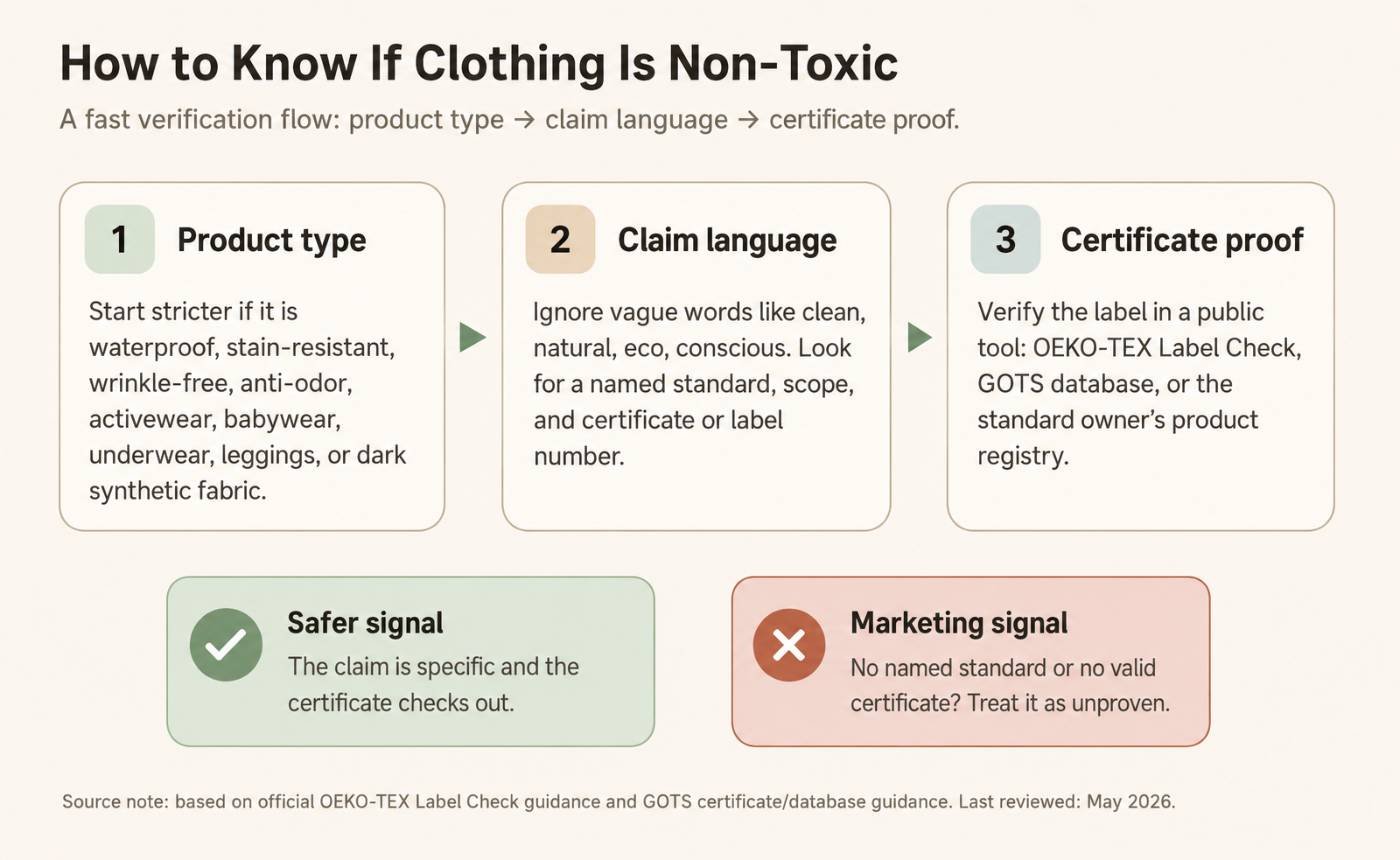
So how do you know? In this guide I’ll walk you through three things I check every time before I buy: the product type, the certification, and the actual wording of the claim.
You will leave with a checklist, the science behind the worst offenders, and a clear picture of what U.S. and international law does (and does not) do to protect consumers.
What "Non-Toxic Clothing" Really Means
There is no legal definition of "non toxic clothing" in the fashion market. None. Brands use it as a marketing word, and it covers everything from a GOTS-certified tee to a polyester dress. That ambiguity is half the reason toxic clothing keeps showing up in well-meaning closets.
When I use the term, I mean a finished garment that has been independently tested against a published list of toxic substances and harmful chemicals, made from natural materials or carefully managed synthetic materials, and sold without vague performance claims that usually require chemical finishes.
A bio-fiber is not automatically a chemically clean finished product. Organic cotton grown without synthetic pesticides can still be dyed with azo dyes, treated with formaldehyde resins, or coated in PFAS chemicals at the finishing stage. The fiber is the beginning. The finishing stage decides whether the clothing is truly free from harmful inputs.
The Global Organic Textile Standard puts it best with its "No hazard in, no hazard out" rule, which prohibits hazardous chemicals across the entire processing chain, not just the cotton field. That is the bar I look for in non toxic clothing brands.
Why Some Clothes Raise Chemical Concerns
Most of the chemicals people worry about in clothing fall into three buckets: water/oil/stain repellents, durable-press resins, and dyes. Each one has a different exposure profile and a different fix.
PFAS and Performance Finishes
Per- and polyfluoroalkyl substances, the "forever chemicals," are the reason your raincoat keeps water beading. The U.S. Environmental Protection Agency notes that the DSSTox database now lists more than 14,700 distinct PFAS compounds, with broader counts approaching 15,000. NIEHS and EPA research links PFAS exposure to kidney and testicular cancer, thyroid problems, immune disorders, and developmental harm.
A 2025 study indexed on PubMed confirms that durable water repellent finishes shed PFAS during normal wear and washing, meaning these toxic chemicals don’t just sit on the jacket. They migrate into laundry water, household dust, and waterways, where they pollute waterways for generations.
The NRDC is blunt: U.S. apparel manufacturers are not generally required to warn consumers about PFAS in clothing, so assume waterproof, stain-repellent, or dirt-repellent labels mean PFAS unless the brand says otherwise.
Formaldehyde, Resins, and "Wrinkle-Free" Claims
Formaldehyde shows up in textiles as a durable-press resin to keep shirts crisp, prevent shrinking, and lock in dye. The International Agency for Research on Cancer classifies formaldehyde as a Group 1 carcinogen, with sufficient evidence for nasopharyngeal cancer (2004) and myeloid leukaemia (2012). Phthalates, used to give prints and synthetic fabrics flexibility, are classified as possible human carcinogens and have been linked in human studies to premature delivery and decreased sperm quality.
That sharp, plastic, slightly chemical smell on a brand-new wrinkle-free shirt? That is often formaldehyde or volatile organic compounds off-gassing.
Two PubMed reviews of textile contact dermatitis point to disperse dyes, formaldehyde, and resins as the leading culprits behind allergic reactions in sensitive skin.
Dyes and Textile Dermatitis
Disperse azo dyes, used heavily on dark synthetic fabrics like polyester leggings, are the second most common cause of textile-related allergic reactions per clinical reviews.
Close-fitting, sweat-warmed garments increase migration of dye into skin. If you keep getting itchy welts under tight black leggings, the dye is a likely suspect.
Toxic chemicals such as formaldehyde and flame retardants can also disrupt hormonal development, which is especially concerning for children.
How to Vet a Garment Before You Buy
This is the part nobody teaches you. Walk through these five filters and you will catch most toxic fashion before it gets near your skin.
Start with Product-Type Risk
Some categories are higher-risk by design: outerwear, performance activewear, anything sold as "wrinkle-free" or "stain-resistant," cheap synthetic underwear, dark synthetic leggings, and treated kids’ pajamas. Start skeptical here. Plain organic cotton tees and linen dresses sit lower on the risk curve.
Read the Claim, Not Just the Vibe
"Eco friendly" is not a certification. "Sustainable" is not a certification. "Clean" is not a certification. If a brand says "free from harmful chemicals" without naming a certification or showing the test, treat it as rather part of marketing, not proof. A real claim names the certification body, the standard, and ideally the certificate number.
Verify the Certificate
For OEKO-TEX, use the public Label Check tool and type in the number on the hangtag. For GOTS, search the Certified Suppliers Database. It takes just a minute.
Know What Each Certification Actually Proves
-
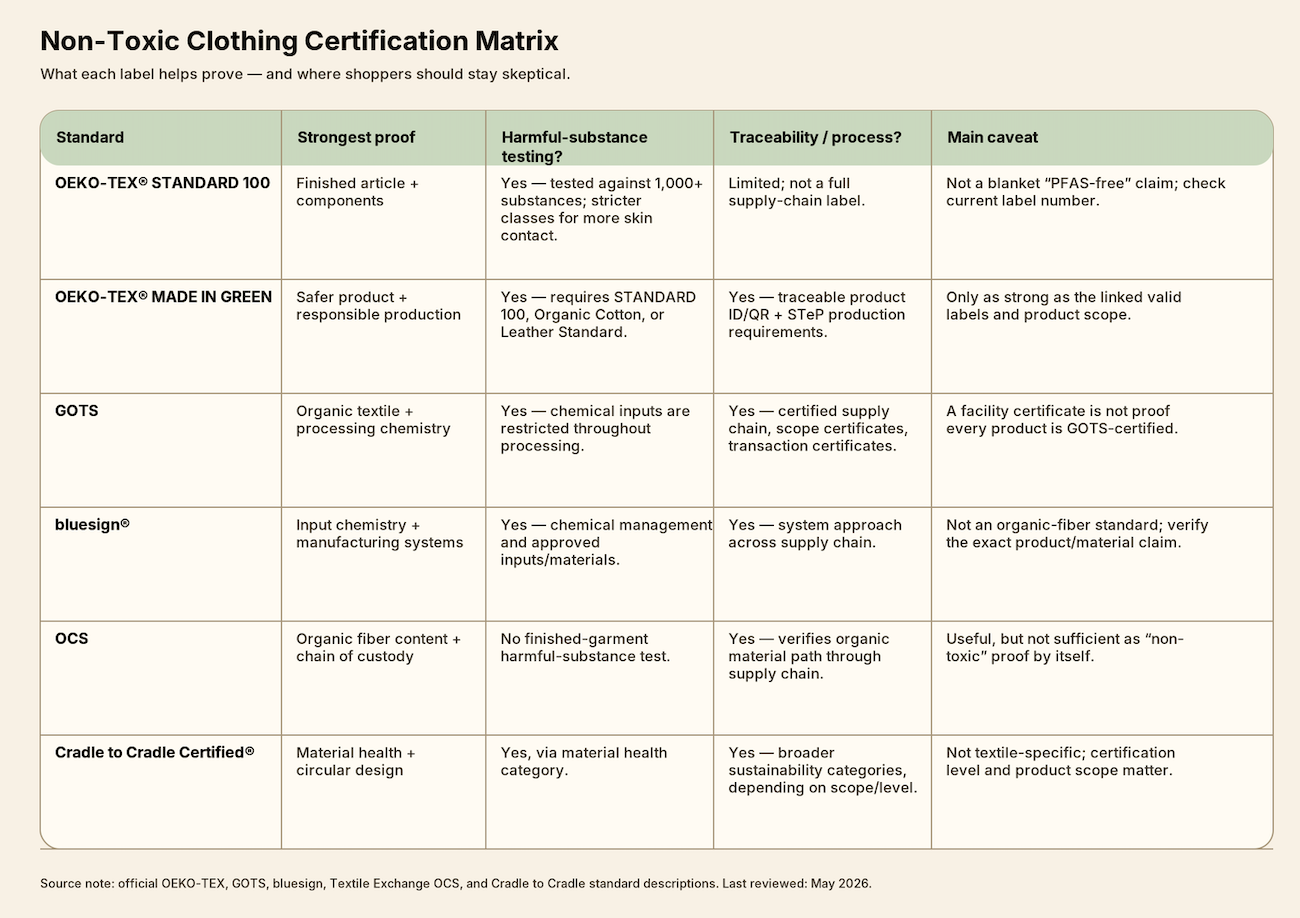
OEKO-TEX Standard 100 — A four-tier certification system that tests the finished article against more than 1,000 toxic substances, with the strictest tier reserved for baby items. Since January 2026, OEKO-TEX has integrated French PFAS limits (25 ppb individual, 250 ppb sum, 50 ppm total fluorine) into STANDARD 100. Important caveat: oeko tex standard 100 tests for substances; it does not certify a garment as "PFAS-free."
-
OEKO-TEX MADE IN GREEN — Adds traceability and sustainable production conditions on top of STANDARD 100 testing.
-
GOTS — The global organic textile standard requires at least 70% certified organic fibers (95% for the full label), bans hazardous chemicals throughout production, and enforces social criteria for workers.
-
bluesign — Audits the entire supply chain for environmental and social responsibility. From January 2025, bluesign APPROVED items must be free of intentionally added PFAS, with all exemptions removed by January 2026.
-
OCS (Organic Content Standard) — Verifies organic fiber content via Textile Exchange. Unlike GOTS, OCS does not regulate finishing chemistry. Useful, but not sufficient on its own.
-
Cradle to Cradle — Adds a circularity layer: materials must be reusable, recyclable, or safely returnable to both the environment and biological cycles.
What Washing Can and Cannot Do
Yes, wash all new clothes before wearing. A first wash removes a meaningful share of residual surface dyes, finishing agents, and loose formaldehyde.
It does not remove covalently bonded resins, in-fiber PFAS, or pigment-bound azo dyes. Washing is harm reduction, not a fix for clothes toxic at the chemistry level.
Which Fabrics and Product Types Deserve Extra Scrutiny?
I get asked this constantly: which natural fabrics are safest, and is polyester always bad?
Better Starting Points
The natural fibers I trust most, paired with end-product testing, are organic cotton, linen, hemp, Tencel lyocell, and merino wool. These natural materials tend to be lower-impact at the farm level and don’t require flame retardants or PFAS-style finishes to perform.
When I shop, I look for organic fibers verified by GOTS and/or an OEKO TEX standard 100 on the finished piece.
Don’t Oversimplify Polyester
Polyester is not automatically poison. Synthetic fabrics like polyester and nylon are problematic when they’re treated with formaldehyde resins, brominated flame retardants, or fluorinated DWR. They’re also a source of microplastic pollution at every wash. Also, research suggests that wearing tight synthetic or plastic‑based clothing while sweating can increase your skin’s exposure to both the chemicals added to them, and microplastic fibers.
But a recycled polyester jacket with bluesign approval and no PFAS finish is a different animal than a $9 fast fashion blouse. Read the claim, verify the standard, and weigh the trade-off.
High-Risk Contexts
Babies, toddlers, underwear, leggings, activewear, and outerwear sit at the top of my caution list because of skin contact, sweat, and hormonal development windows.
The Texas Attorney General’s April 2026 Civil Investigative Demand to Lululemon is a current example worth watching. Texas alleges potential PFAS in activewear marketed as wellness-focused; Lululemon says it phased out intentionally added PFAS in fiscal 2023 and is cooperating. An investigation is not a finding. But it’s a reminder that even premium clothing brands deserve verification, not trust by reputation.
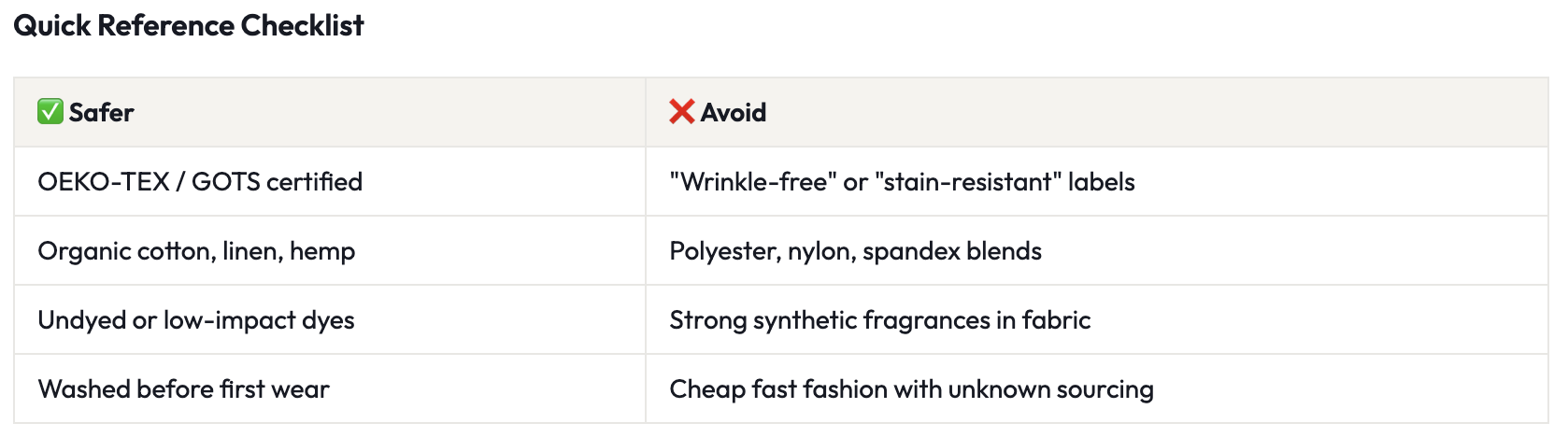
A Practical Checklist You Can Use in Under Two Minutes
When I’m shopping for non toxic fashion, this is exactly what I run through:
-
Identify the product type. High-risk (outerwear, activewear, wrinkle-free, baby) gets stricter scrutiny.
-
Read the claim language. "PFAS free," "GOTS certified organic cotton," "bluesign APPROVED" beat "eco friendly alternatives" or "clean."
-
Find the certification number. A real certificate has an ID. No ID, no claim.
-
Verify it. OEKO-TEX Label Check or the GOTS Certified Suppliers Database.
-
Check the fiber content. Prioritize natural fibers — organic cotton, linen, Tencel, hemp, merino, organic fleece — over untraceable synthetic blends.
-
Smell the garment. Sharp, plastic, or chemical odor is a red flag for formaldehyde or VOCs. Walk away.
-
Wash before wearing. Always. It reduces residual finishing chemicals and surface dye.
My Three Priorities Going Forward
If I leave you with anything, let it be this. First, vague language is a tell. Brands that genuinely make safer fabrics name their certifications and show their work. Sustainable brands earn their language; toxic fashion borrows it.
Second, certifications are tools, not gospel. OEKO-TEX, GOTS, bluesign, and OCS each prove something specific. Stack them. A garment with both GOTS and OEKO-TEX gives you organic fibers and a tested final product — that combination is what I look for in non toxic fabrics for everyday clothing.
Third, your buying choices are policy. Every time you choose pfas free, every time you support sustainable apparel and fair trade clothing brands, every time you reject fast fashion in favor of organic materials, you’re voting for environmental sustainability and the well being of garment workers, your family, and yourself.
If you want help getting started, my team’s non toxic clothing brands guide and our low tox shop are good places to begin. Browse the rest of the Orbasics blog for posts on clean beauty, GOTS-certified organic clothing, and non-toxic home swaps.
Frequently Asked Questions
How to tell if your clothes have toxic chemicals?
Trust your nose, your eyes, and the label. A sharp, plastic, or pungent smell often signals formaldehyde or VOCs. "Wrinkle-free," "stain-resistant," "water-repellent," and "anti-odor" claims usually require harmful substances. Verify any non toxic claim with an OEKO-TEX or GOTS certificate number. No verifiable certification means treat it as conventional clothing.
What is the 3-3-3 rule for clothes?
This is a wardrobe minimalism rule, not a chemistry rule: three tops, three bottoms, three pairs of shoes that all coordinate, producing roughly 27 outfits. It’s a sustainable clothing strategy that pairs naturally with non toxic fashion — fewer, better pieces, made from natural fibers, verified once and worn for years. It reduces consumption, microplastic pollution, and greenhouse gases.
Can toxins be washed out of clothes?
Partly. Washing reduces surface residues of dyes and loose formaldehyde, but it cannot remove chemically bonded resins or in-fiber PFAS. Always wash new clothing before first wear, and combine that habit with informed choices about what enters your closet in the first place.
What fabrics are non-toxic to wear?
The safer baseline is GOTS-certified organic cotton, linen, hemp, Tencel lyocell, and untreated merino wool, paired with end-product testing under oeko tex standard 100. These natural fabrics avoid most flame retardants, azo dyes, and PFAS finishes. Pure natural fibers don’t guarantee non toxic — finishing matters too.
Does OEKO-TEX mean PFAS-free?
No. STANDARD 100 tests for restricted PFAS and applies a total fluorine limit, but the certification itself does not declare a product "PFAS-free." For PFAS-specific assurance, look for explicit "intentionally added PFAS-free" claims or bluesign APPROVED status alongside OEKO-TEX.
Is organic cotton automatically non-toxic?
No. Organic cotton certifies the fiber, not the dye, finish, or trim. A garment can be organic cotton and still carry azo dyes or formaldehyde. Look for organic cotton plus a finished-product test like oeko tex standard 100, or a full GOTS certificate covering the whole supply chain.
Can PFAS be in waterproof clothing?
Often, yes. Most waterproof and stain-resistant performance gear has historically used pfas chemicals. New laws are forcing change, and many sustainable brands now offer pfas free alternatives using silicone, polyurethane, or wax-based finishes. Verify the claim.
Is polyester toxic to wear?
Not inherently, but conventional polyester is often paired with toxic chemicals at the finishing stage and contributes to microplastic pollution. A bluesign-or OEKO-TEX 100 approved, PFAS-free recycled polyester is a reasonable sustainable alternative for some uses; a cheap untreated polyester blouse from the fast fashion industry is not.
What is the difference between GOTS and OCS?
GOTS covers organic fibers plus the entire processing chain: chemicals, dyes, social criteria, wastewater. OCS verifies organic fiber content only. GOTS is stricter and the better choice for non toxic materials end to end.
Do U.S. laws already protect me from toxic clothing chemicals?
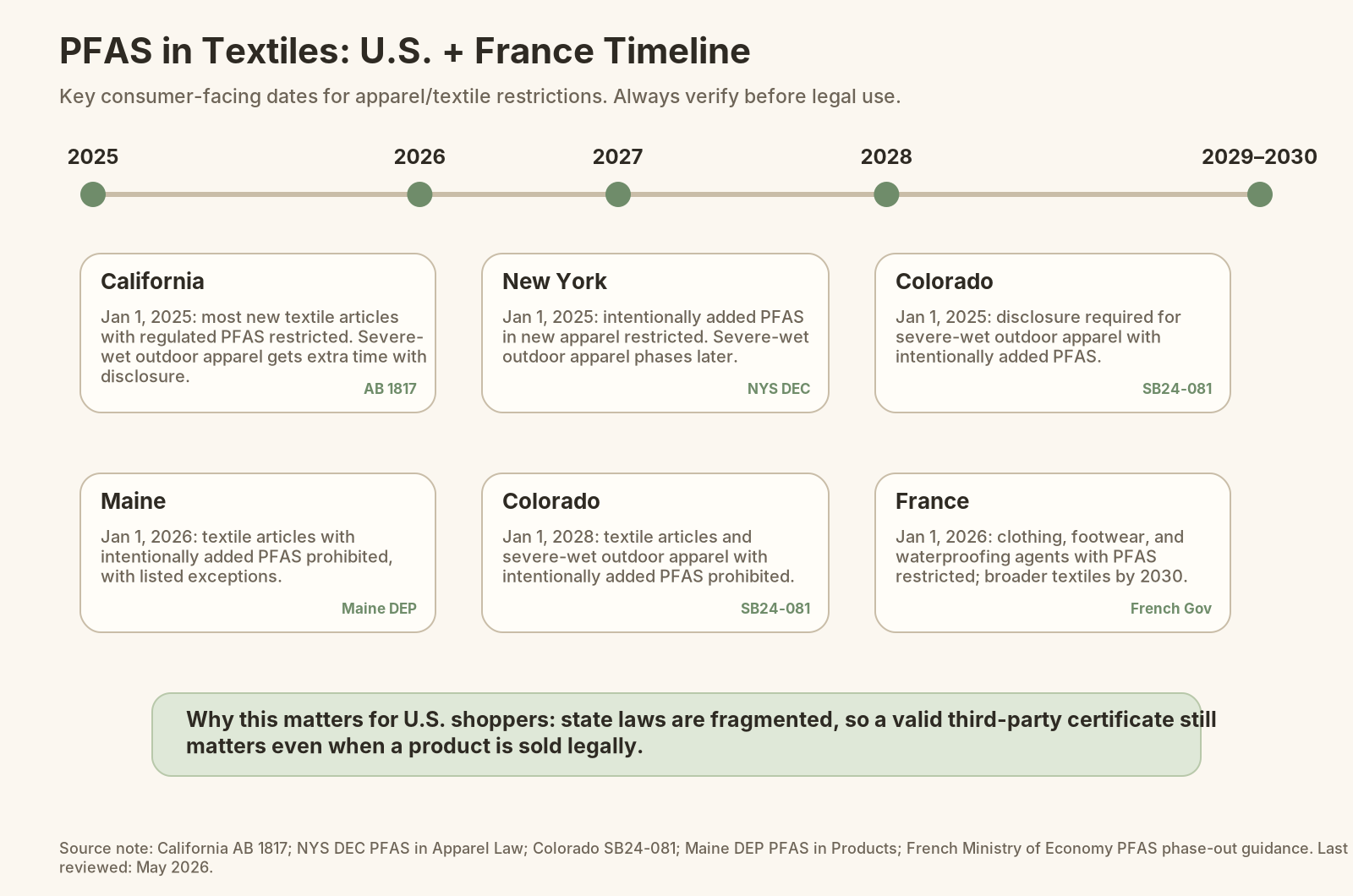
Partially. California, New York, Colorado, and Maine restrict intentionally added PFAS in apparel and textile articles. There is no federal ban, no required hazard label on hangtags, and no requirement to eliminate pfas across the U.S. textile industry. Eco-conscious resources like Eco-Stylist and small editorial shops — including, occasionally, a classic t shirt company built on organic cotton — are filling the information gap until policy catches up. Until then, your best protection is a verified certificate, a careful eye, and the seven-step checklist above.
*Advertisement: This article contains affiliate links marked with*. If you make a purchase through these links, we may earn a small commission at no additional cost to you.
The information provided is for educational and informational purposes only and is not intended as medical advice. It should not replace consultation with your physician or qualified healthcare provider. This article was created with the assistance of AI tools and has been editorially reviewed and approved by our team. All opinions expressed are our own.
Lilija Bairamova

Lilija is the founder of Orbasics, a brand born from her passion for creating a healthier, more sustainable world, starting with organic, toxin-free clothing for children. As a mother committed to a non-toxic lifestyle, Lilija has spent years exploring and embracing clean beauty, non-toxic living, and holistic wellness. She shares her expertise on everything from natural personal care to creating toxin-free home environments, offering practical tips and in-depth guides that empower you to make healthier choices and lead a more mindful, health-conscious life.






Leave a comment